
SUICIDE SQUAD
(1959)
The original Suicide Squad appeared in six issues of The Brave And The Bold (Vol. 1); their very first appearance was in #125 (1959). The team later appeared in Action Comics (Vol. 1) #552 (1984). Though the earliest incarnation of the team did not have the espionage trappings of later Squads, it laid much of the groundwork for Squad field leader Rick Flag, Jr.'s personal history.
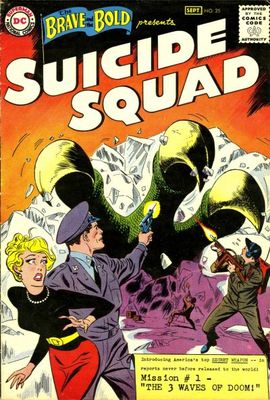
The Brave & The Bold (Vol. 1) #25 (1959)
|
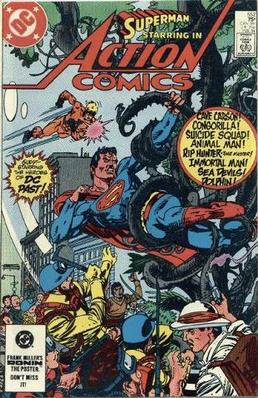
Action Comics (Vol. 1) #552 (1984)
|
In the wake of DC's line-wide Crisis On Infinite Earths event, several new book launches were conceptualized, with writer John Ostrander assigned the task of resurrecting the Suicide Squad for an ongoing monthly series. While Ostrander initially found the concept absurd, he soon hit upon the government black ops hook. The team (and its administrator Amanda Waller) were introduced in the Legends mini-series (6 issues), with the original Silver Age Squad's back-story fleshed out further in Secret Origins (Vol. 2) #14 and modern Suicide Squad member Nightshade getting her own origin story (involving the Squad) in Secret Origins (Vol. 2) #28.
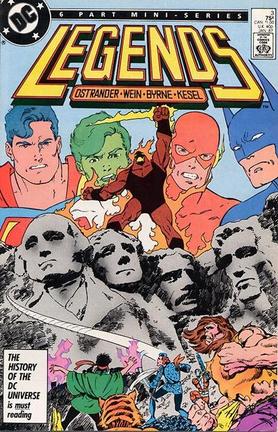
Legends #3 (1987)
|
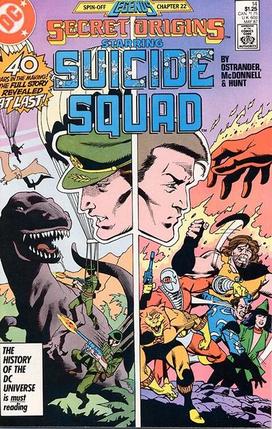
Secret Origins (Vol. 2) #14 (1987)
|
Vol. 1
The first volume of Suicide Squad, written by modern Squad creator John Ostrander, launched in May 1987, shortly after the team was introduced in the Legends crossover event. It lasted for 66 monthly issues, along with one annual and one special (Doom Patrol & Suicide Squad Special #1), both published in 1988.
Notable team members from Suicide Squad (vol. 1) include:
Notable team members from Suicide Squad (vol. 1) include:
- Amanda Waller;
- Rick Flag, Jr.;
- Bronze Tiger;
- Captain Boomerang (George Harkness);
- Count Vertigo;
- Deadshot;
- Doctor Light (Arthur Light);
- Duchess (Lashina);
- Enchantress;
- Jewelee;
- Nemesis (Tom Tresser);
- Nightshade;
- Oracle (Barbara Gordon);
- Poison Ivy;
- Punch;
- Ravan;
- Shade, the Changing Man;
- Thinker (Cliff Carmichael);
- Vixen.
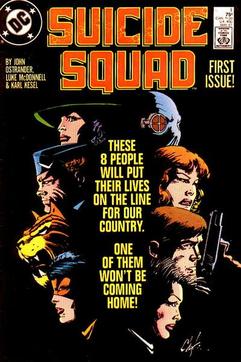
Suicide Squad (Vol. 1) #1 (1987)
|
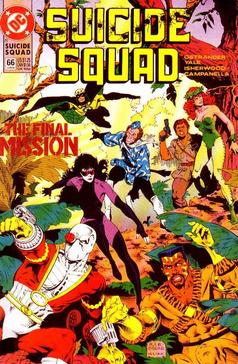
Suicide Squad (Vol. 1) #66 (1992) (FINAL ISSUE)
|
Collected Editions (Vol. 1)
- Suicide Squad, Vol. 1: Trial by Fire (collects Suicide Squad (Vol. 1) #1-6 and Secret Origins (Vol. 2) #14;
- Suicide Squad, Vol. 2: The Nightshade Odyssey (collects Suicide Squad (Vol. 1) #9-16);
- Suicide Squad, Vol. 3: Rogues (collects Suicide Squad (Vol. 1) #17-25, Annual #1).
Though Ostrander's Suicide Squad (Vol. 1) series was canceled in 1992 with issue #66, the concept lived on in various DC story-lines throughout the years:
- Superboy (Vol. 3) #13-15 (1995);
- Hawk & Dove (Vol. 4) (5-issue limited series) (1997-1998);
- Chase (Vol. 1) #2 (1998);
- Superman: Our Worlds at War Secret Files & Origins #1 (2001);
- Adventures Of Superman (Vol. 1) #594 (2001).
Vol. 2
Keith Giffen's short-lived Suicide Squad run (which began in November 2001 and lasted 12 issues) follows a new version of the Squad, designated ''Task Force Omega'', and run by Sgt. Frank Rock. Together with his right-hand (and wheelchair-bound) man Bulldozer, Rock taps new characters Havana and Modem to round out the team's mobile HQ. President Lex Luthor and Secretary of Metahuman Affairs Amanda Waller are shown to be supplying the Squad's assignments.
Notable team members from Suicide Squad (Vol. 2) include:
Notable team members from Suicide Squad (Vol. 2) include:
- Amanda Waller;
- Sgt. Frank Rock (implied to be an impostor);
- Big Sir;
- Bulldozer;
- Clock King (William Tockman);
- Cluemaster;
- Deadshot;
- Havana;
- Killer Frost (Louise Lincoln);
- Major Disaster;
- Modem;
- Multi-Man.
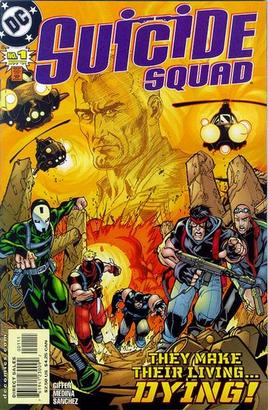
Suicide Squad (Vol. 2) #1 (2001)
|
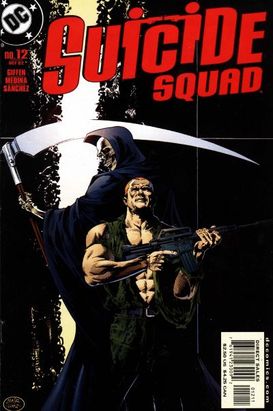
Suicide Squad (Vol. 2) #12 (2002)
|
Interim Stories (Between Vol. 2-3)
Amanda Waller and the Suicide Squad were heavily involved in the events and fallout of 52.
During much of this time, Waller ran the Squad covertly, due to her station as the White Queen of Checkmate (DC's other government agency). This inter-faction tension is a recurring theme throughout many Squad stories of this era.
During much of this time, Waller ran the Squad covertly, due to her station as the White Queen of Checkmate (DC's other government agency). This inter-faction tension is a recurring theme throughout many Squad stories of this era.
- Superman (Vol. 2) #182 (2002);
- Superman: Secret Files & Origins 2004;
- 52 (2006-2007);
- Checkmate (Vol. 2) #6-7 (2006);
- Salvation Run (7-issue mini-series, 2007-2008);
Vol. 3
John Ostrander returned to the Suicide Squad for an eight-issue mini-series, starting in November 2007. The series takes place roughly between the Squad's appearance in Checkmate (Vol. 2) #6-7 and the events of Salvation Run (as Amanda Waller has already been ousted from her position at Checkmate, but Deadshot and Chemo are still with the Squad and not exiled). It is functionally a sequel to the Checkmate arc, detailing how Rick Flag, Jr. survived his apparent death before returning to Waller's Suicide Squad.
DC Comics' official solicitations consistently referred to the mini-series as Suicide Squad: Raise The Flag, though this nomenclature is never used within any individual issue or collected edition of the miniseries.
Notable team members from Suicide Squad (Vol. 3) include:
DC Comics' official solicitations consistently referred to the mini-series as Suicide Squad: Raise The Flag, though this nomenclature is never used within any individual issue or collected edition of the miniseries.
Notable team members from Suicide Squad (Vol. 3) include:
- Amanda Waller;
- Rick Flag, Jr.;
- Blackguard;
- Bronze Tiger;
- Captain Boomerang (Owen Mercer);
- Chemo;
- Count Vertigo;
- Deadshot;
- King Faraday;
- The General;
- Marauder;
- Multiplex;
- Plastique;
- Thinker (Cliff Carmichael);
- Twister;
- White Dragon (William Heller);
- Windfall.
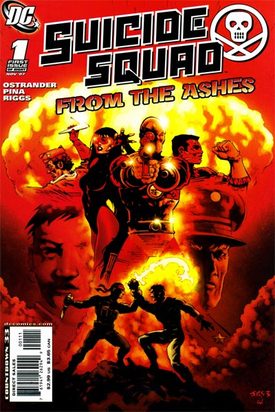
Suicide Squad (Vol. 3) #1 (2007)
|
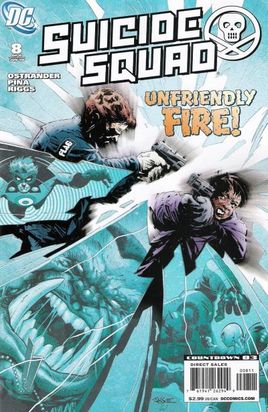
Suicide Squad (Vol. 3) #8 (2008)
|
Collected Editions (VOL. 3)
- Suicide Squad: From The Ashes (collects Suicide Squad (Vol. 3) #1-8;
- Secret Six: Danse Macabre (collects Secret Six (Vol. 3) #15-18 and Blackest Night: Suicide Squad #67 (see below).
Interim Stories (Between Vol. 3-4)
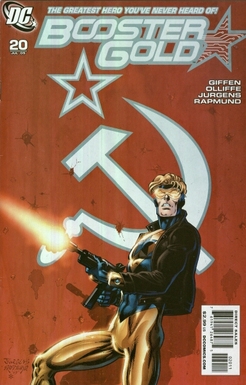
The Squad made prominent appearances in a four-issue Manhunter (Vol. 4) arc and during the Blackest Night crossover event. Suicide Squad (Vol. 1) #67 was released over a decade after the last issue - considered final at the time - as part of a Blackest Night tie-in series of resurrected titles. In his multiverse-spanning adventures, Booster Gold briefly cooperated with a version of the Silver Age Squad.
These issues mark the Squad's final appearances prior to DC Comics' New 52 continuity reboot in 2011.
These issues mark the Squad's final appearances prior to DC Comics' New 52 continuity reboot in 2011.
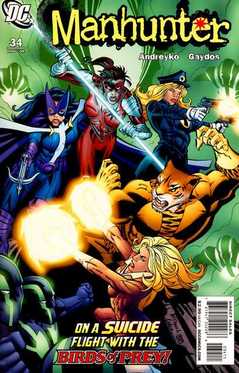
Manhunter (Vol. 4) #34
|
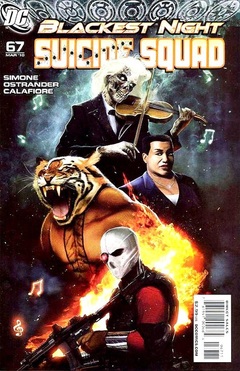
Suicide Squad (Vol. 1) #67 (2010)
|
Booster Gold (Vol. 2) #20 (2009)
Vol. 4
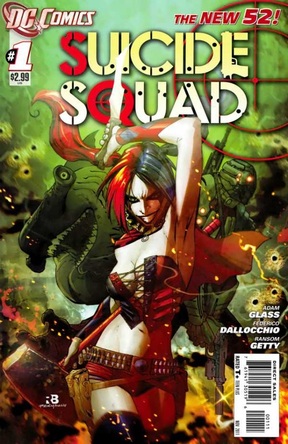
A new Suicide Squad title launched in September 2011 as part of The New 52 (a reboot of the DC Comics universe). Amanda Waller once again directs a crew of black ops agents on covert government missions, with Deadshot serving as the field team's leader.
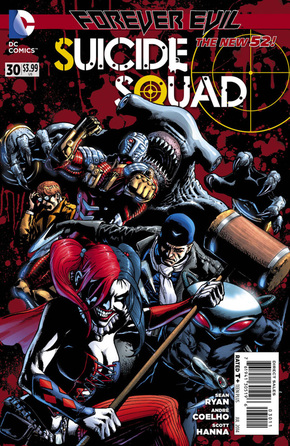
This volume of Suicide Squad ran for 32 issues (#1-30, #0 and one special titled Suicide Squad: Amanda Waller #1).
Notable team members from Suicide Squad (vol. 4) include:
This volume of Suicide Squad ran for 32 issues (#1-30, #0 and one special titled Suicide Squad: Amanda Waller #1).
Notable team members from Suicide Squad (vol. 4) include:
- Amanda Waller;
- Black Spider (Eric Needham);
- Captain Boomerang (George Harkness);
- Deadshot;
- El Diablo (Chato Santana);
- James Gordon, Jr.;
- King Shark;
- Harley Quinn;
- The Unknown Soldier;
- Yo-Yo.
Suicide Squad (Vol. 4) #1 (2011)
|
Suicide Squad (Vol. 4) #30 (2014) (FINAL issue)
|
Collected Editions (Vol. 4)
- Vol. 1: Kicked in the Teeth (collects Suicide Squad (Vol. 4) #1-7);
- Vol. 2: Basilisk Rising (collects Suicide Squad (Vol. 4) #8-13, #0 and Resurrection Man (Vol. 2) #9);
- Vol. 3: Death Is For Suckers (collects Suicide Squad (Vol. 4) #14-19);
- Vol. 4: Discipline And Punish (collects Suicide Squad (Vol. 4) #20-23, Detective Comics (Vol. 2) #23.2, and Justice League Of America (Vol. 3) #7.1);
- Vol. 5: Walled In (collects Suicide Squad (Vol. 4) #24-30 and Suicide Squad: Amanda Waller #1);
New Suicide Squad
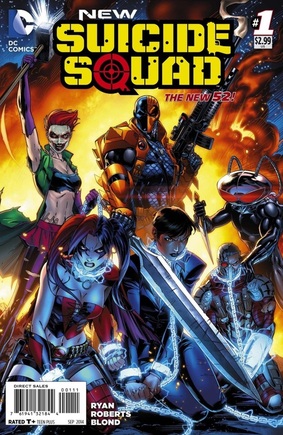
This 2014 relaunch sees Deadshot and Harley Quinn teaming up with new Squad members Black Manta, Joker's Daughter and the Reverse Flash. Deathstroke was an initial member of the revamped roster in issue #1, but quickly turned on his "teammates" in the following issue.
New Suicide Squad #1 (2014)
